One of my clients once said, “Nobody likes oysters on the first try.” True. I did not like them on the first try either, nor on the second, nor on the third. However, after visiting the French town of Cancale I found out that I had been eating oysters in the wrong places.

An oyster Creuses-de-Cancale №1, Cancale, France.
Do you know the “R” rule for oysters? You should eat them only in those months which have the letter R in their names: January, February, March, April, September, October, November, and December. But if you want to try really fresh oysters at any time of year you need to go to the place they inhabit, or where they are being grown. The French town of Cancale in Brittany (not to be confused with Great Britain) is one such place. So the seaside town of Cancale, which is considered to be the French “oyster capital,” was among the places to visit during our trip around Normandy and Brittany.
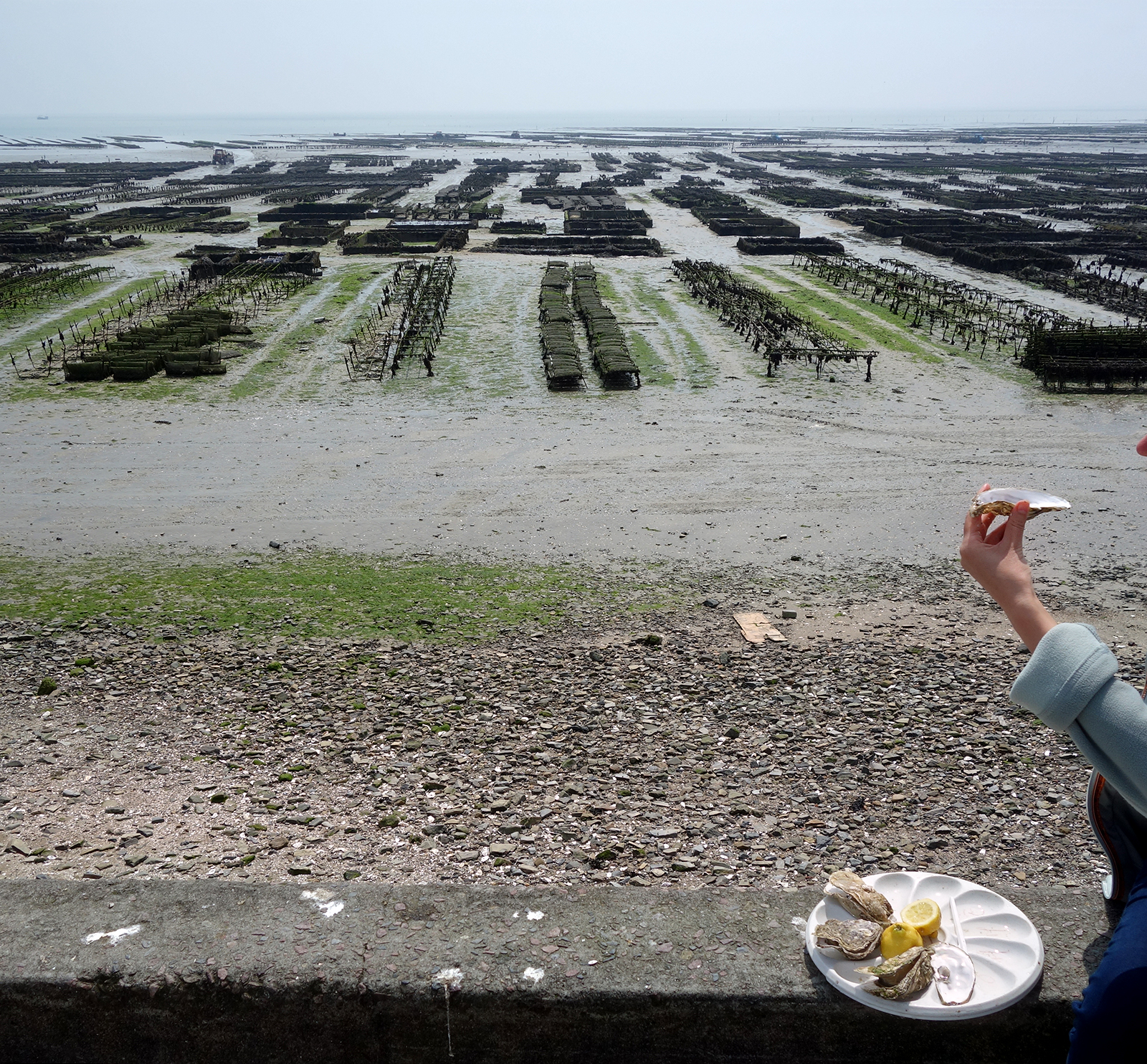
The very next morning after our arrival and finding accommodation near one of the wonders of the world, Mont Saint-Michel (just look at our photographs), we went to Cancale to try all the delights of the sea cuisine offered by this small town. First impression? An absolute ecological disaster! There is NO SEA; only a huge grey sea bottom stretching to the horizon.
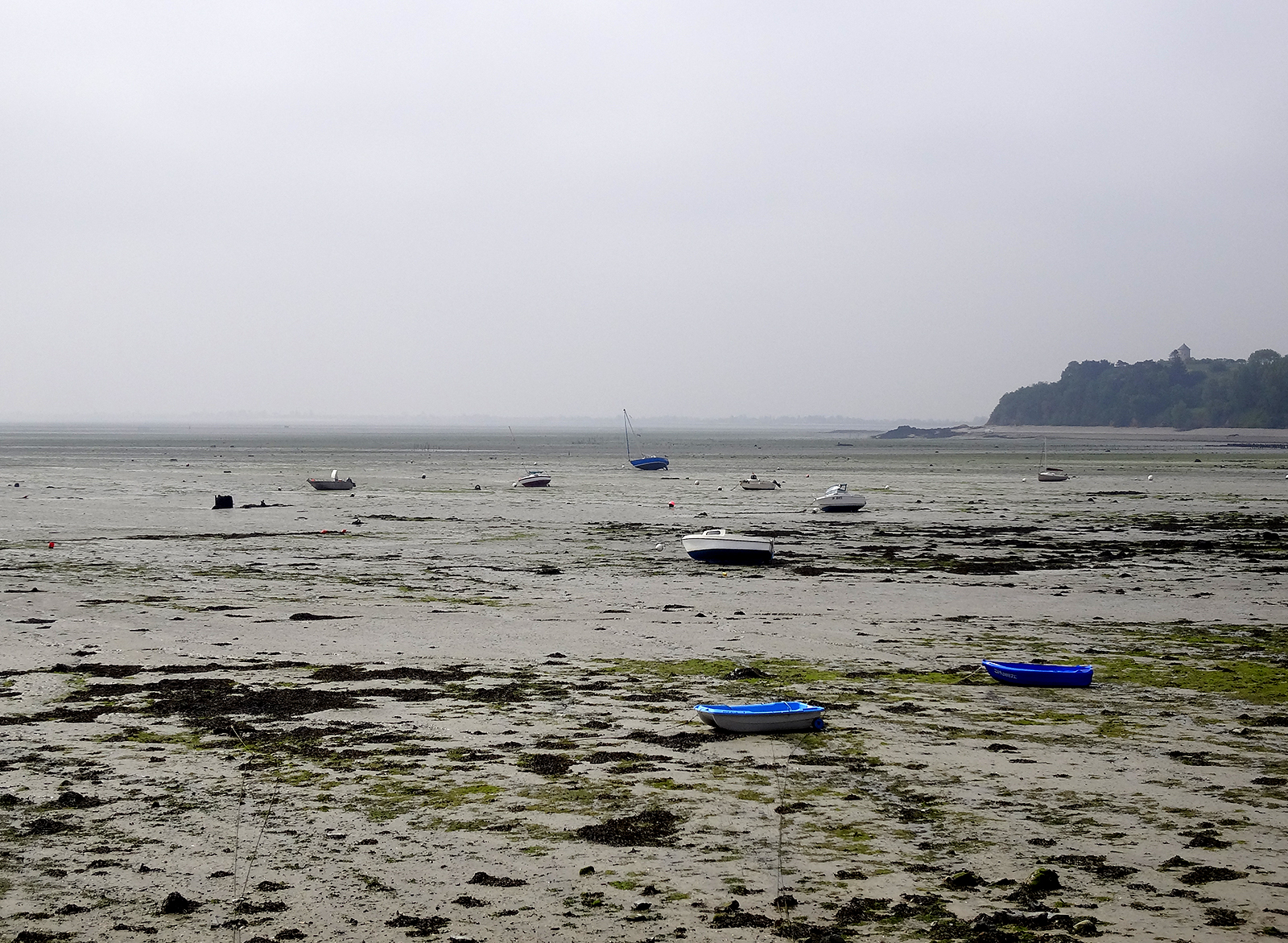

Boats of different sizes, lying on their side like so many beached whales, are all over the place. There is no sea here. Probably, the ecologic balance was disrupted by the restoration works around Mont Saint-Michel due to which the whole area of the oyster bay was drained, and people lost their sea. But how about oysters? The quay is full of different restaurants. In fact, it has nothing but seafood restaurants and bars. This is a complete collapse for them!
My mind was filled with such thoughts while we were walking along the quay reading menus and thinking what we were going to have for lunch. Since my Irina is a seafood fan, Cancale is heaven on earth for her. To be honest, we were looking for a certain oyster bar, Au Pied d’cheval providing the widest choice of oysters for several generations already. We have read about it in the Internet. We had not found it, but there were plenty of other bars and cafes.
All menus still contained seafood items. Where do they get seafood considering the lack of the sea? Step by step we reached a place well known to all lovers of oysters, a tiny market on the beach of Cancale near the oyster farm, where you can buy the freshest oysters for the price of a loaf of bread (well, a bit more expensive). The variety is striking.
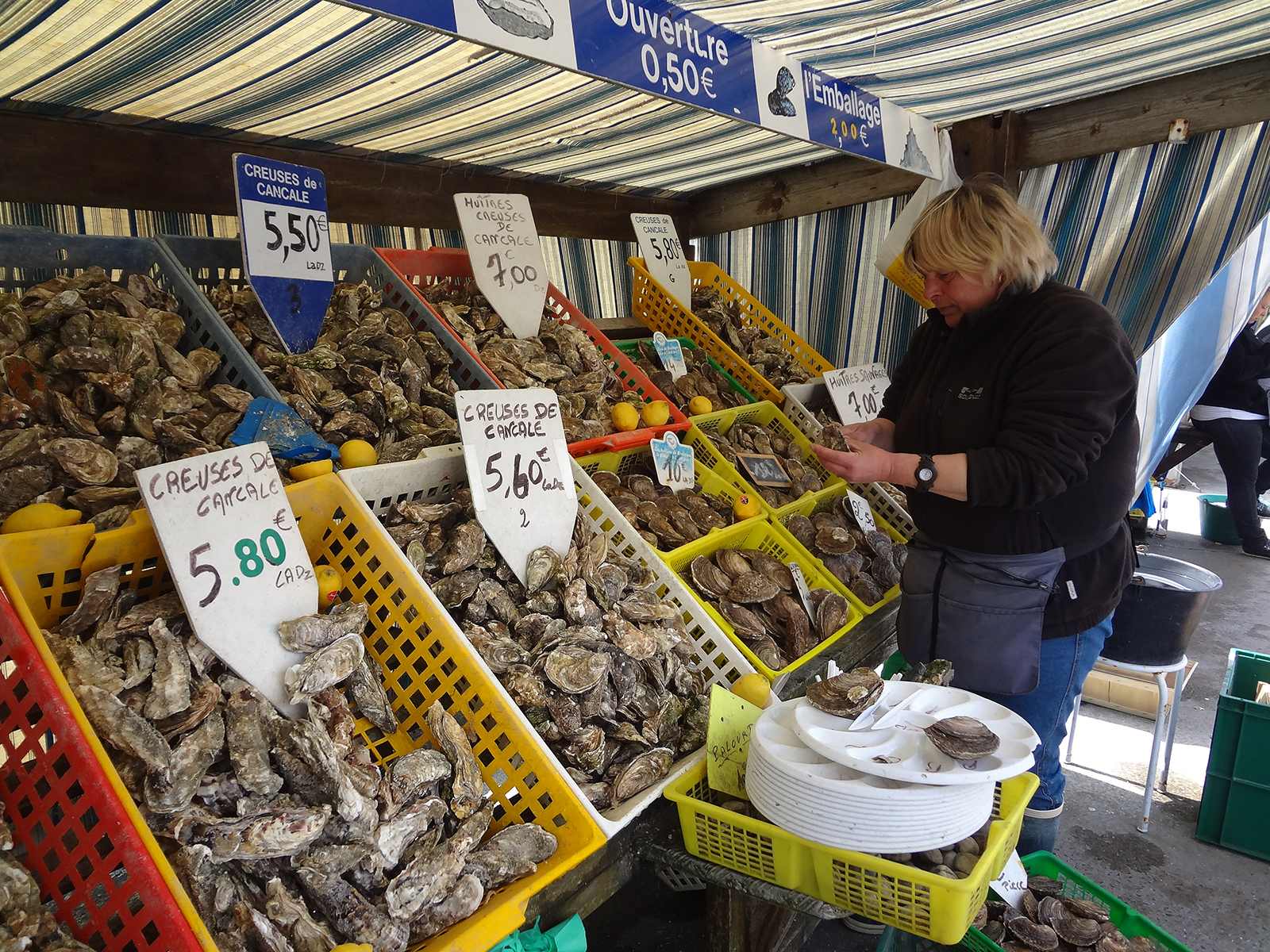
Irina chose two different types of oysters: a dozen of popular Crassostrea gigas and a couple of rare Pied de Cheval Huitre. The saleslady explained that one type should be drizzled with lemon, but the other one not, because they are salty themselves. The empty shells should be thrown into the sea and the plates returned to her. Again the sea?! You don’t have any sea here!
Like backpackers on a budget, we made ourselves comfortable at the concrete dike with a view of the oyster farm and started the ingestion. It was hard to stop Ira, and impossible to catch up to her. That’s why I ate a couple of different oysters in a hurry trying to lose my mind in happiness, but I felt nothing. I was still obsessed with the thought: where is the sea?
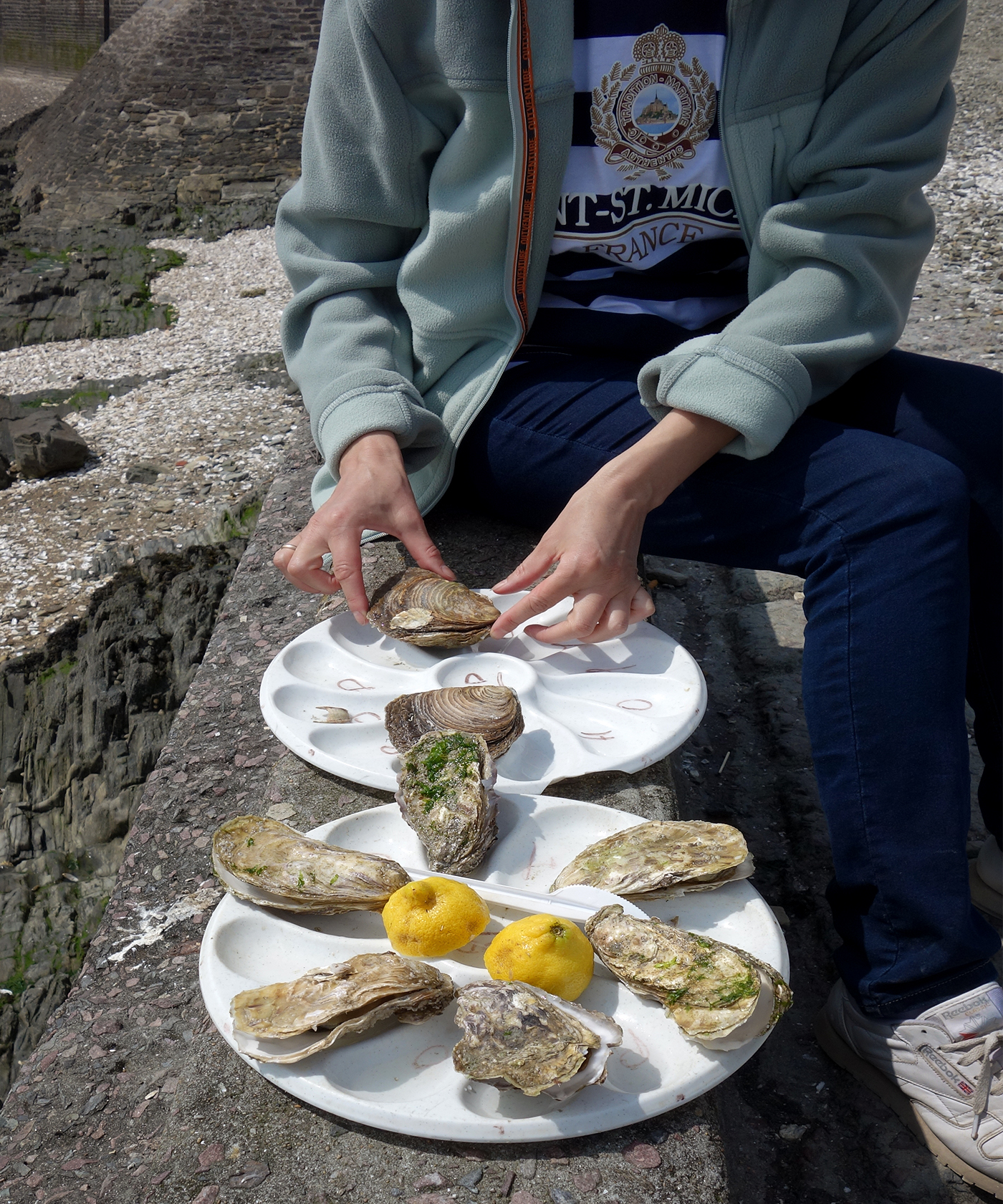
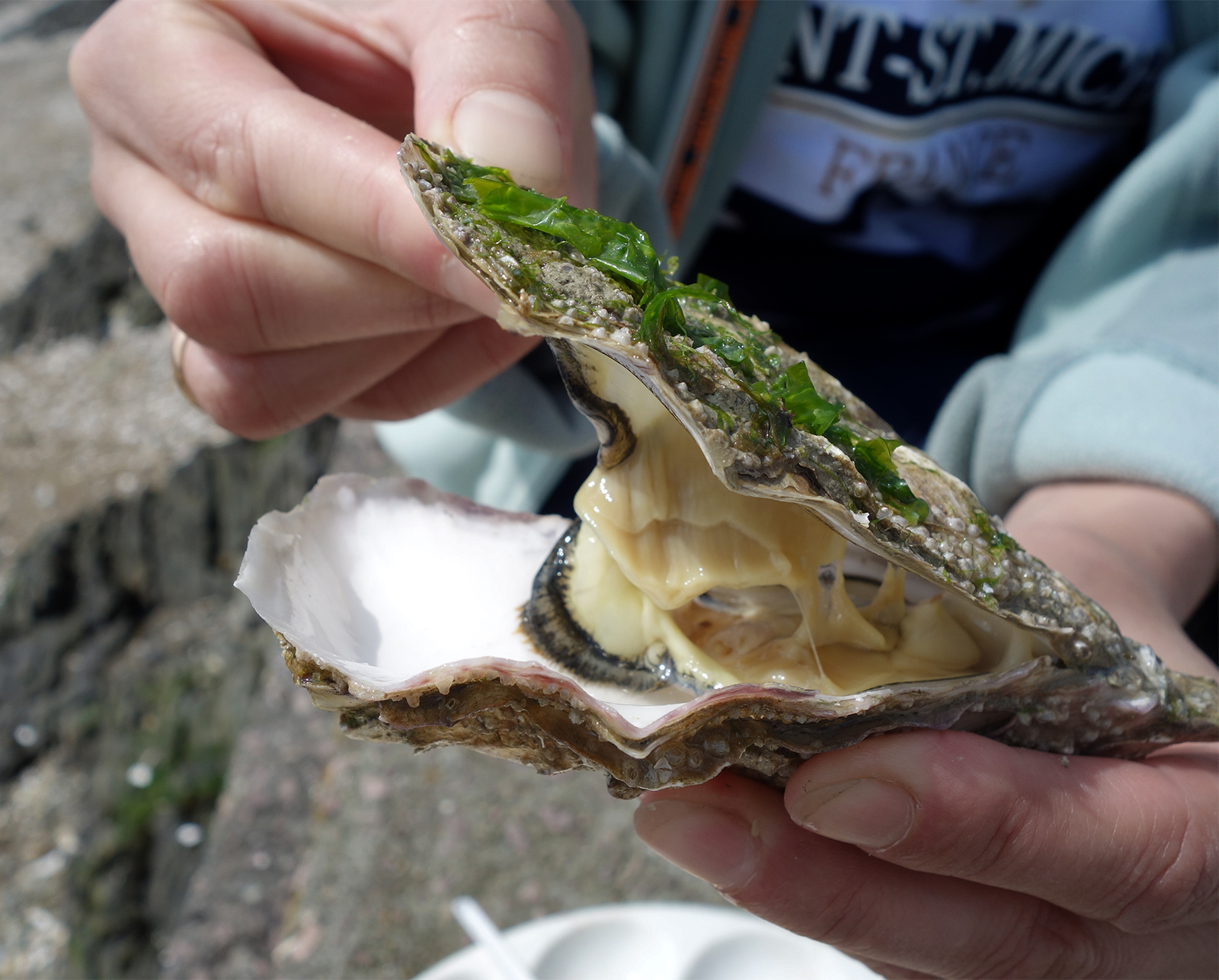
An oyster Creuses-de-Cancale.
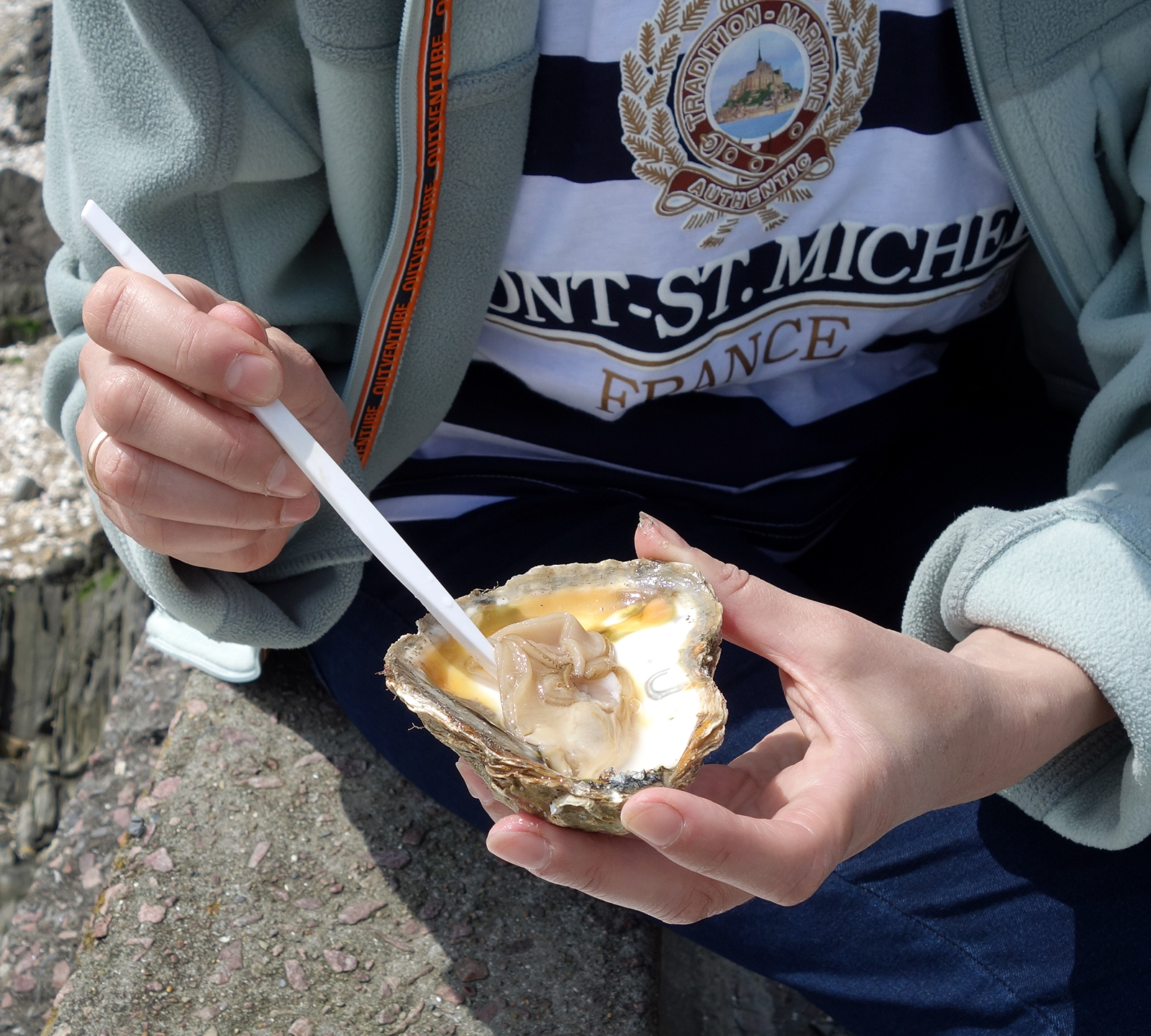
An oyster Pied-de-cheval.
Obediently, we threw the oysters shells on the stones under our feet, assuming it was the “sea.” All the rest was returned to the saleslady. After leaving the market, Ira announced she wished to find some seafood restaurant for lunch. But I was more interested in the answer to the question: Could I find a chunk of good meat here, or I would be dying of hunger till evening, when we’ll return to our Mont Saint-Michel, to a famous restaurant where they prepare lamb nourished with grass grown on a salty soil (l’agneau de pre-sale) periodically flooded by the English Channel waters?
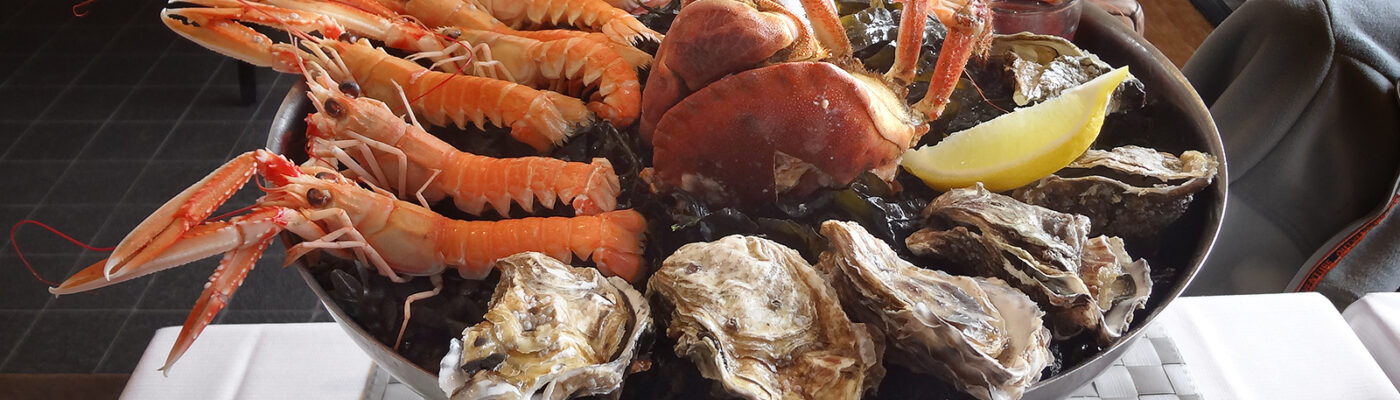
After thirty minutes of investigating all provided menus, we finally chose a restaurant and ordered a huge dish of everything inhabiting the local waters for Ira, and a glass of white wine and a cup of coffee for me.
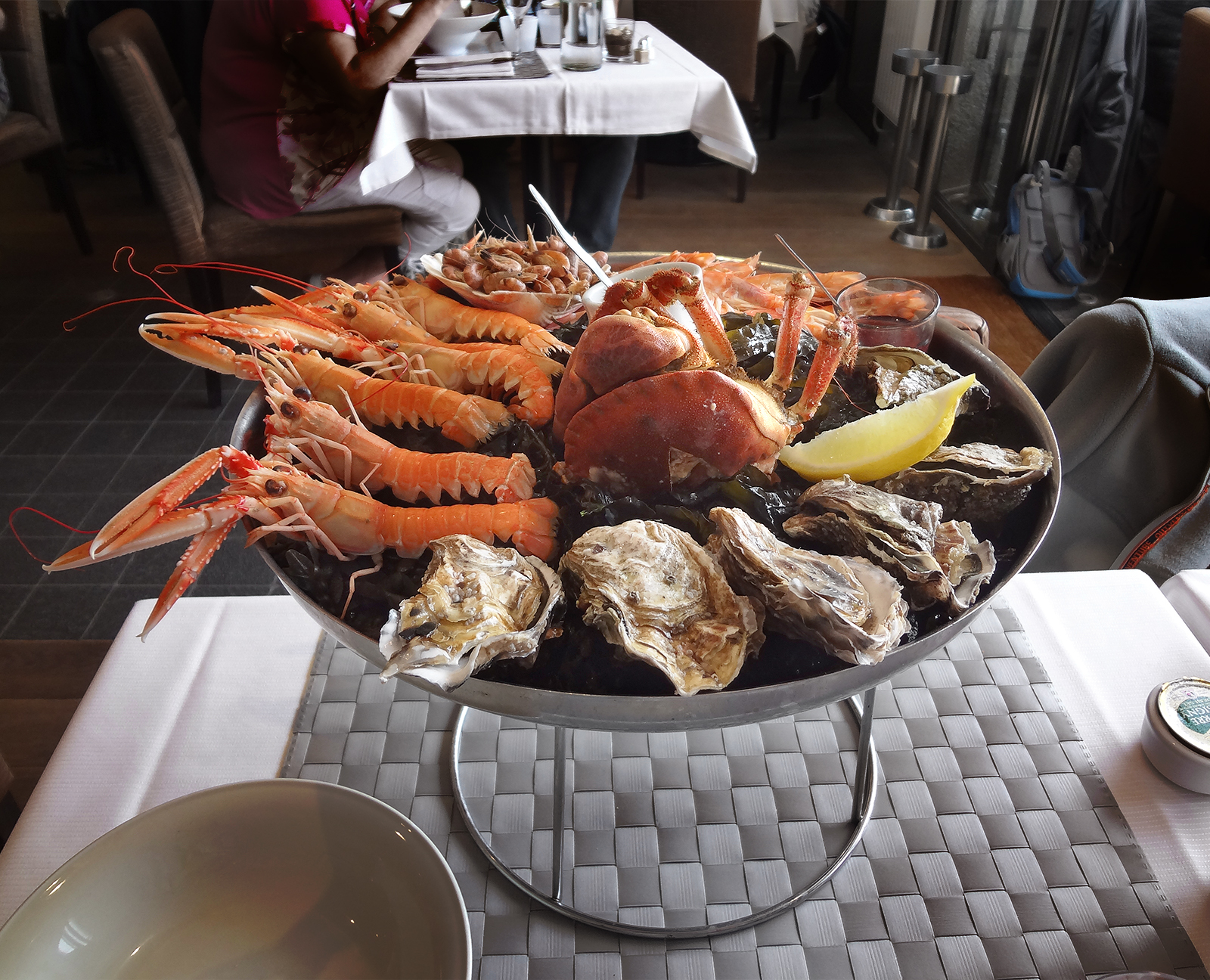
“It was amazing!” Ira said.
My white wine was not bad, but the coffee… as always in France. By the way, I ordered a gourmet coffee which means coffee with three or four types of the special sweet-stuff with—supposedly—a mind-blowing taste. The desserts failed to save the taste of the coffee although everything together looked a-la French stylish.
After this, our visit to Cancale came to an end and we slowly drove to our hotel Les Vieilles Digues enjoying the surrounding views of Brittany (I mentioned it was not Great Britain?) and the empty sea bottom, and periodically pulling to the side of the road to give way to those who had not drunk any white wine.
However I was still concerned with the question: where is this sea?
Later on, we had a nice dinner in the above-mentioned restaurant where we tried not only salt grass-fed lamb, but a marvelous carrot cream soup and oysters as well. And I heard a voice, “A dinner with oysters and white wine tomorrow in Cancale.” Although that was said in French, I understood it—I don’t know French—and translated to Irina. She willingly agreed. Sure thing, I cannot remember her rejecting any dinner, certainly not with oysters, nor with white wine, and especially not in France.
On the next day, we walked around the whole Mont Saint-Michel, getting up at 5 a.m. in order to start the photo session right with the sunrise. In the evening, we got into our pretty car BMW MINI Country to visit Cancale again; 50 km from Mont Saint-Michel.
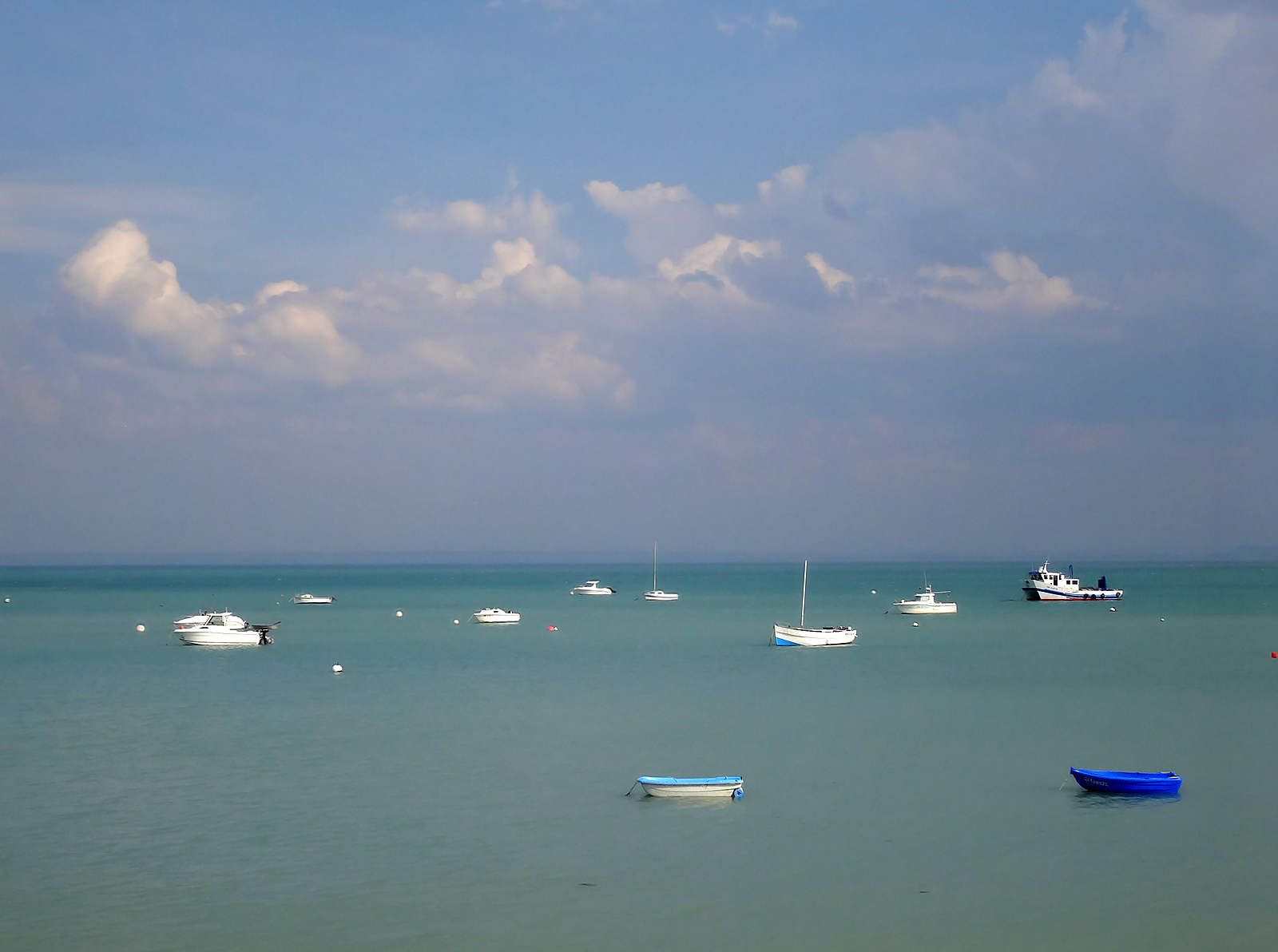
Just when we entered the oyster bay of Cancale, I saw the sea in its own place, sky-blue as on the Maldives, soft (I nearly said warm; but no, it is not warm at all in Brittany in June) and huge, up to the horizon. All “dead” ships and boats were cheerfully dancing on the waves, and a sense of happiness for all the people living in Cancale invaded me. Everything is OK here, just the way it should be in a marine town, although only in the evenings; but not everybody is as lucky as the Greeks or the Italians who always have the sea in place.
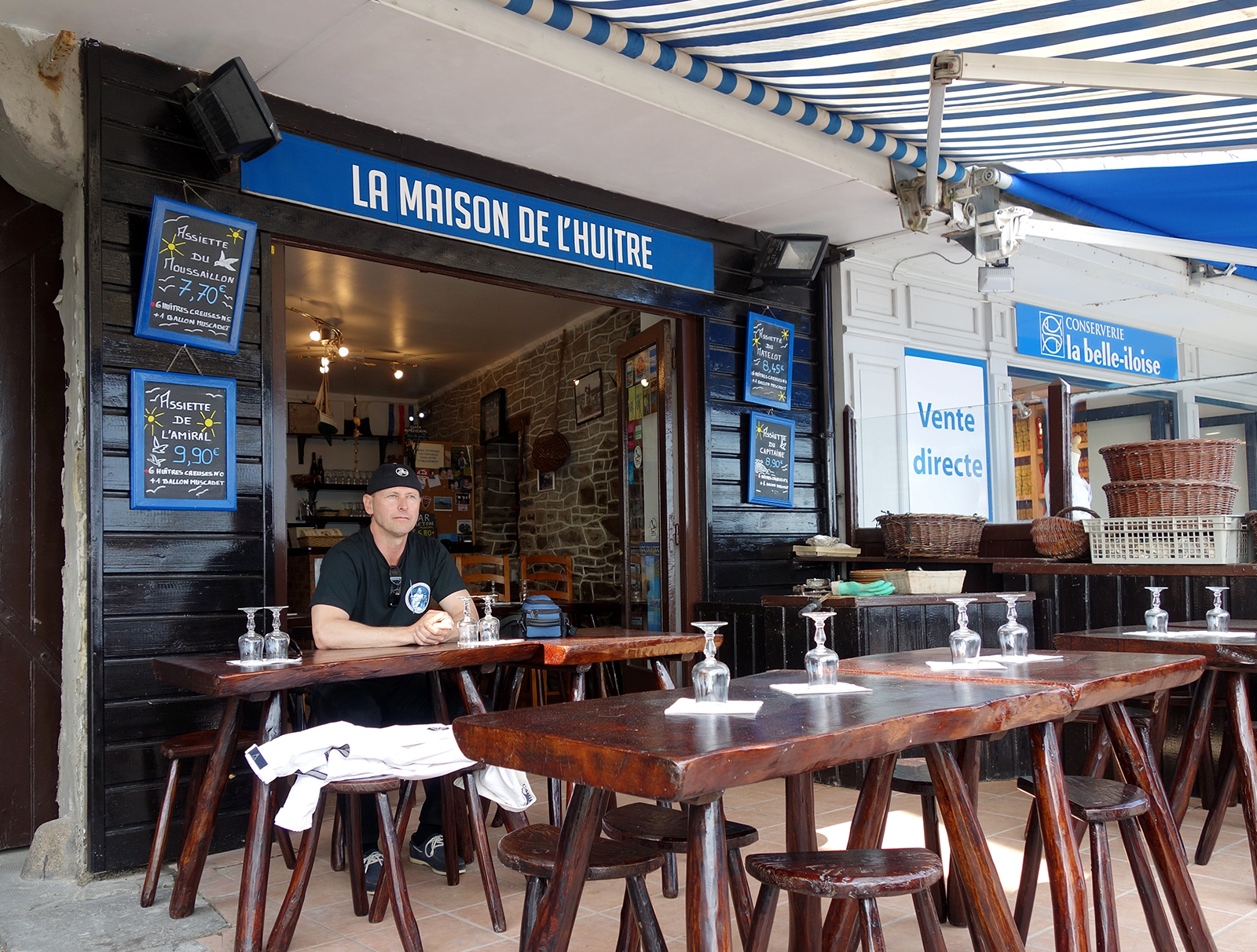
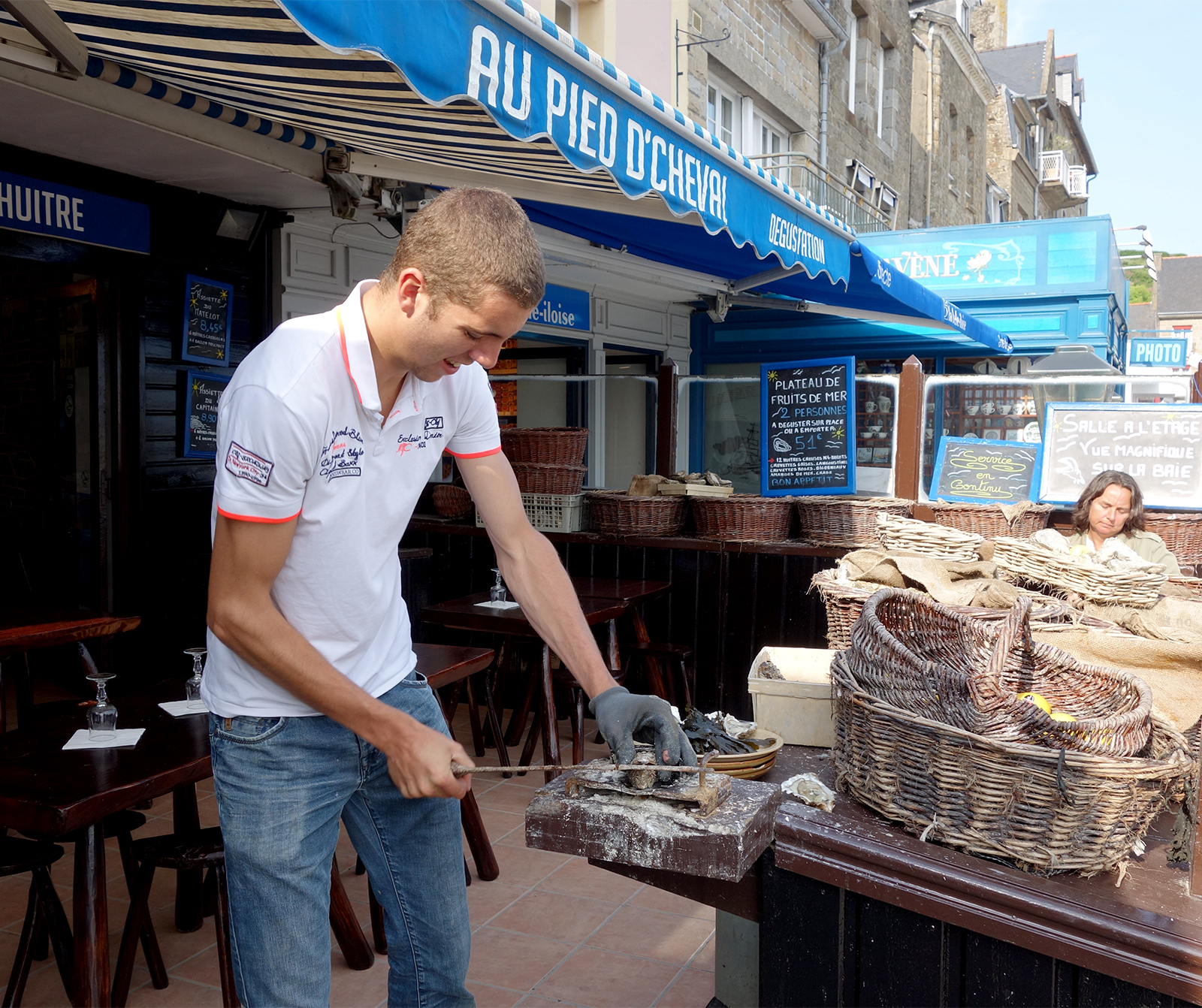
Parking. The ticket vending machine operates with coins–I needed change. So I went to the cafe opposite and asked for change. When I returned, Irina said to me, “Look at the signboard. This is Au Pied d’cheval that we unsuccessfully searched for yesterday.” It is fate. The voice guided us to that very oyster bar that we wanted to visit yesterday, but failed to find. Our oyster festival began.
The counters were full of oysters of different sizes and types. We tried everything (they are numbered: the higher the number, the smaller the size/age and price), washing it down with a great French white wine. I ate them and did not recognize myself: I never thought I could eat so much. Do you think we received a shocking bill? Yes, indeed; it was shockingly low. The owners of the restaurant decided to follow the decor of a simple fisherman interior and simple fisherman prices. I am not a fisherman but I liked it.
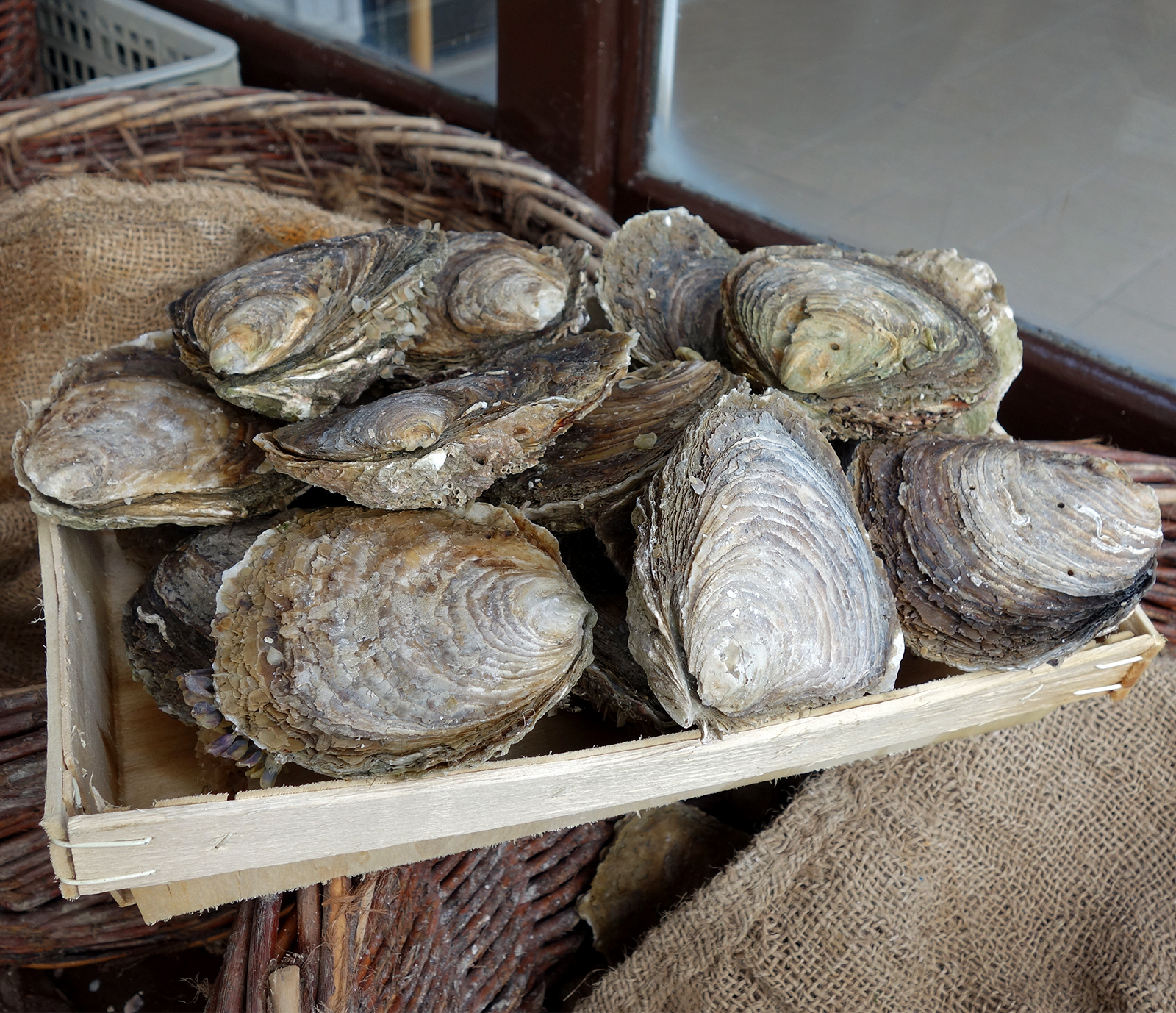
Oysters Pied-de-cheval.
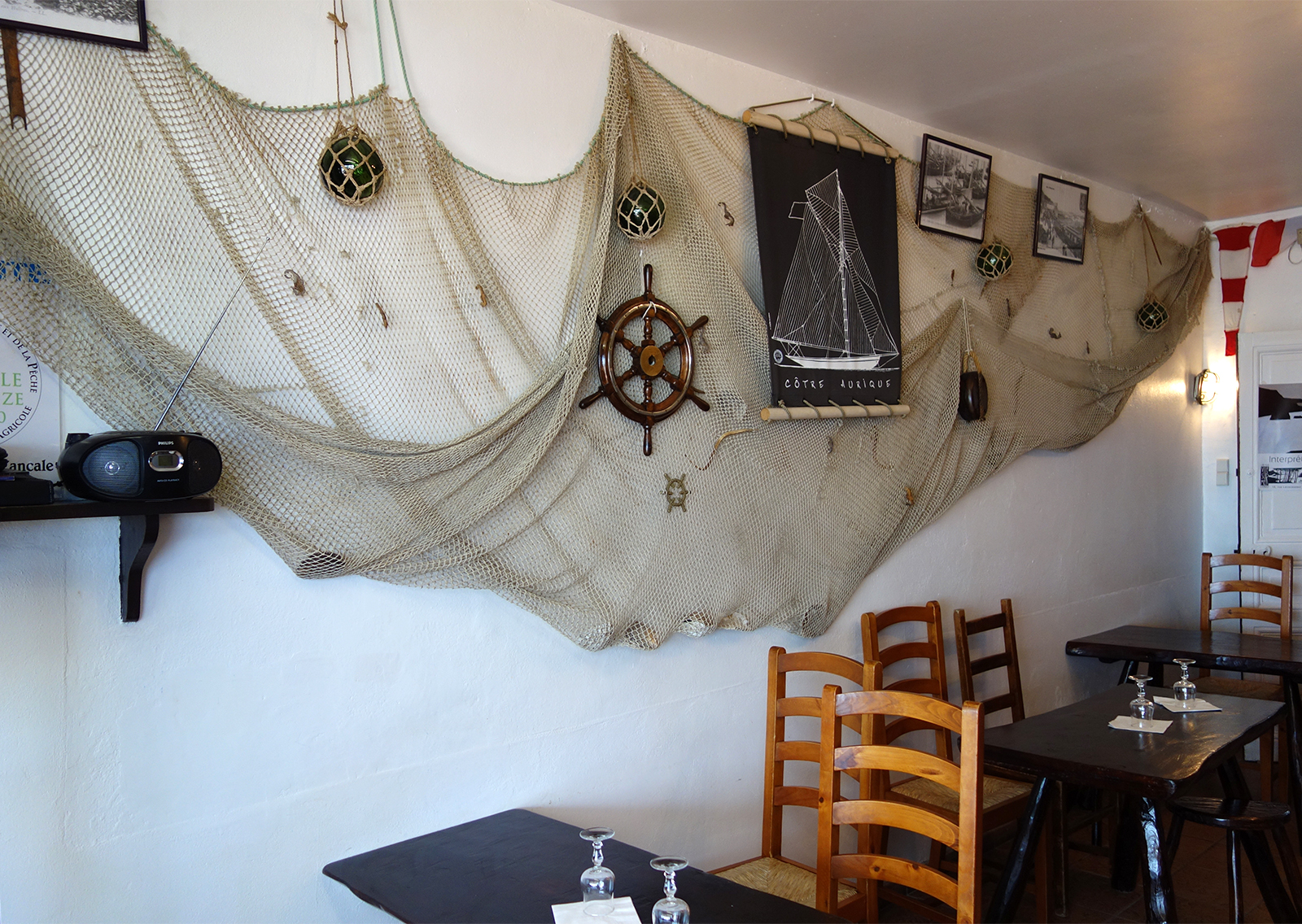
The Pied-d-cheval restaurant in Cancale.
That day, we drove back to our hotel much more slowly.
History of Brittany’s oysters
Cancale is located on the so-called Emerald Coast of France; the water is really emerald-green—of course, only when it is actually present. This town is called the oyster capital of Brittany because more than half of its population of five thousand are involved in the breeding and trade of the oysters, and the others serve the tourists who come here in order to relish this dainty dish.

Если вам удобнее получать анонсы наших очерков через МАКС, подпишитесь на наш канал!
There is some evidence that oysters were shipped via the Seine to Lutetia (future Paris) from the 3rd to the 5th centuries. After the medieval slack, the oyster fashion revived in Europe thanks to Louis XIV, the Sun King. By the middle of the 19th century, the oyster reserves were exhausted and the French government issued a decree that oysters were to be gathered only during months containing the letter R in their name, and in no case from May to August. According to another version: in summer, the oysters are concerned with the future generation and lose their flavour due to the “affairs of the heart.”
The measures undertaken did not save the situation; the French oysters kept disappearing.
The next decree approved the import of oysters Crassostrea angulata from Portugal. The consequences were catastrophic: “emigrants” managed to colonize the whole Atlantic coast having completely displaced the native inhabitant of these places, the flat oyster Ostrea edulis, which the Sun King so enjoyed.
At the end of the 1960s, the local oyster farms found themselves on the verge of the bankruptcy; their plantations were killed by epidemics. The French had to turn to the help from abroad which means to import the young Japanese oyster Crassostrea gigas similar to the Portuguese but bigger, and—most importantly—resistant to virus.
Today creuse oysters (fr. creuse – hollowed out), looking like small stony clenched fists, have almost displaced the production of the flat oysters from most of the French oyster regions. The real legendary European oyster Ostrea edulis survived in Croatia, that’s why the exclusive French oyster farms were purchasing the oysters there after the epidemics.
You may also try the rare oysters, for example, the «horse’s hoof» (Pied de cheval) which are collected in the sea rather than being grown on farms. One such oyster costs much as a dozen of the “Japanese.”
One of the main characteristics of any oyster is its size. For creuse oysters these are №5 – №4 – №3 – №2 – №1 – №0 – №00 where №5 is the smallest and №00 is biggest. The number three (from 80 to 100 grams) is the size most in demand in Europe, but you know, the smallest №5 oysters were no worse than the big ones. So, here is my advice: try everything!
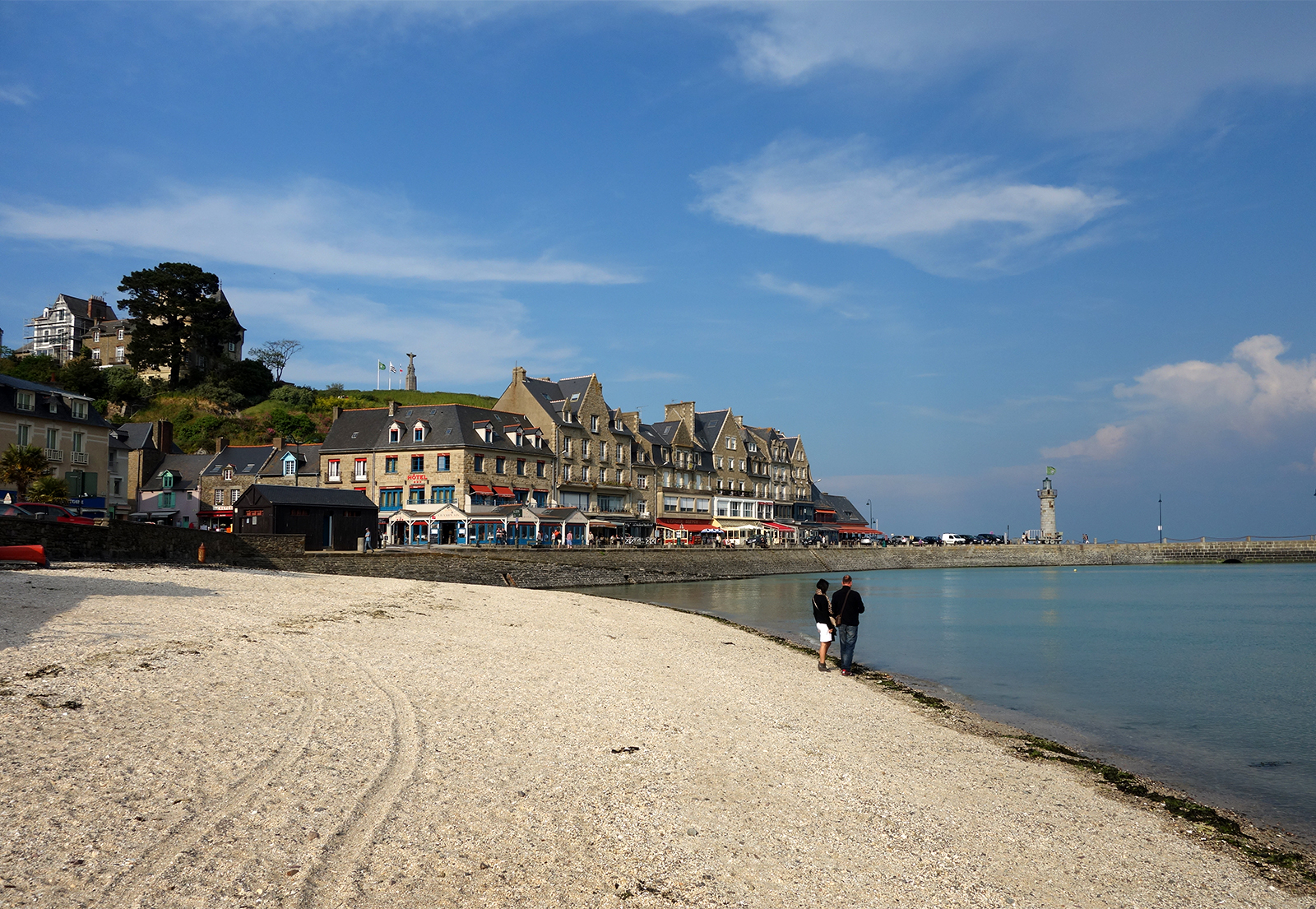
Cancale, the “oyster capital” of France.
Happy travels!
